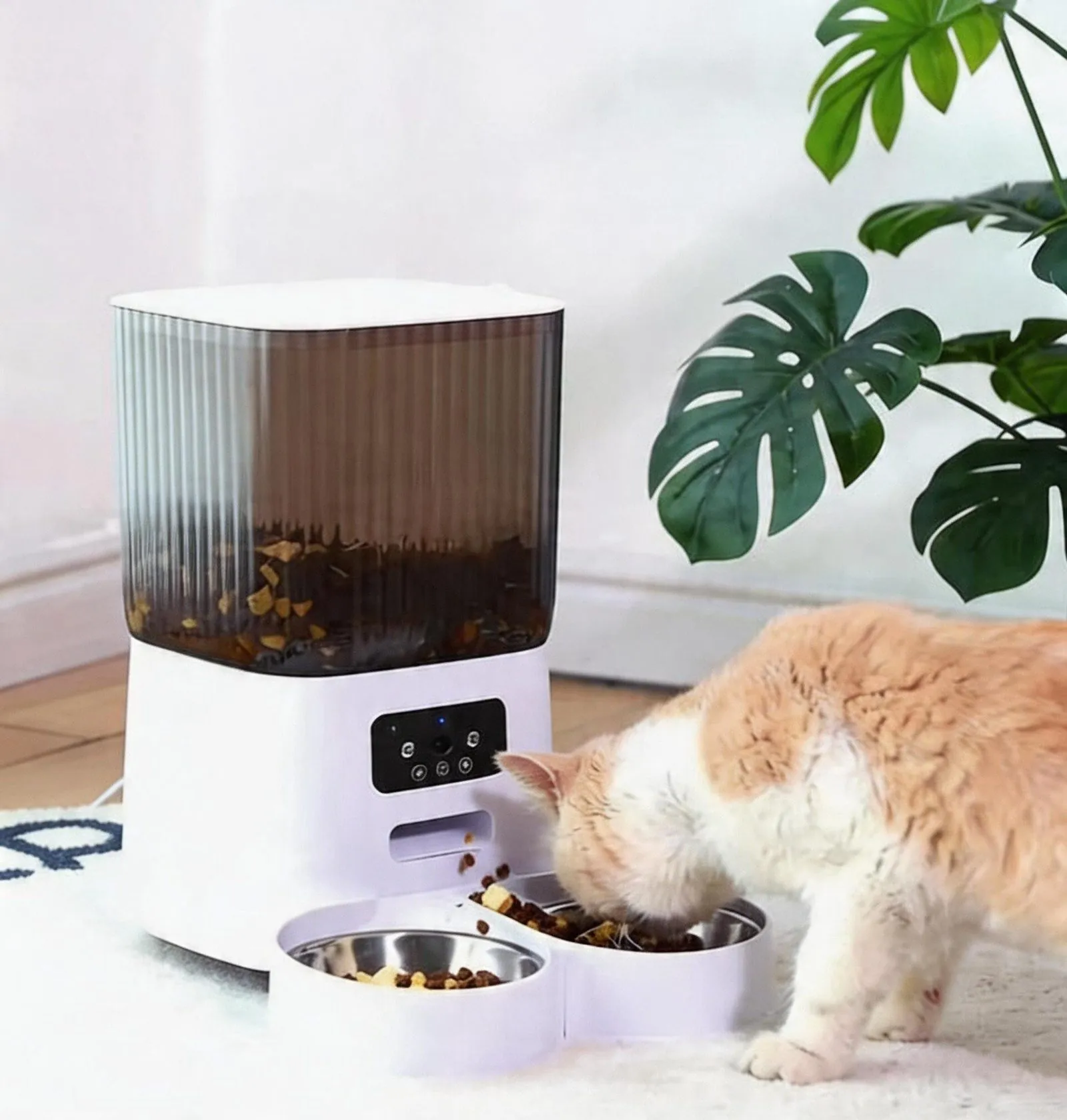
How Do You Compare Different Cat Automatic Pet Feeder Models?
To compare a cat automatic pet feeder, evaluate its Wi-Fi performance, dispensing consistency, food storage design, cleaning requirements, and build quality. Check actual product specifications, test repeated feeding cycles, and compare warranty terms and total purchasing costs before selecting a model for retail or wholesale distribution.
- ConnectivityCheck Wi-Fi compatibility, app functions, and offline feeding behavior.
- Dispensing PerformanceCompare portion consistency using the same dry cat food and repeated tests.
- Food StorageExamine lid sealing, removable parts, cleaning access, and material documentation.
- Product QualityEvaluate mechanical reliability, electrical safety, and manufacturing consistency.
- Commercial ValueCompare unit prices, MOQ, warranty, OEM customization, and repeat-order stability.
1. What Is a Cat Automatic Pet Feeder?
A cat automatic pet feeder is a device designed to dispense dry cat food according to programmed feeding schedules. Depending on the model, it may allow users to set feeding times, select portion settings, and provide meals without manually filling a bowl every time.
A traditional automatic feeder usually operates through built-in controls and a programmed dispensing mechanism. A smart cat feeder may also connect to a mobile application through Wi-Fi, allowing users to manage supported feeding functions remotely.
Common features include:
- Programmable feeding schedules.
- Adjustable food portions.
- Dry food storage compartments.
- Automatic food dispensing.
- Manual feeding controls.
- Wi-Fi and mobile app connectivity on smart models.
- Battery backup on selected models.
- Detachable food containers and feeding bowls.
Not every model includes all these functions. Some feeders offer basic scheduled feeding, while more advanced versions provide remote feeding through an app. Other models may include additional features depending on their configuration.
What Problems Does It Solve?
For consumers, an automatic cat feeder helps maintain regular feeding times when they are working, travelling, or managing a busy daily schedule. It can reduce the need to release every meal manually, but it does not replace fresh water, routine checks, or human care.
For pet product retailers and importers, the product can serve different customer segments:
- Entry-level programmable feeders for price-conscious buyers.
- Wi-Fi smart feeders for consumers who want app-connected feeding functions.
- Larger-capacity feeders for households with different feeding requirements.
- Premium models with additional functions and upgraded designs.
Understanding these differences helps buyers match a model to its intended retail position.
2. Smart Features and Connectivity: Wi-Fi, App Control, and Remote Feeding Compared
Smart connectivity is one of the main differences between a basic automatic cat feeder and a Wi-Fi-enabled model. However, having a mobile application does not automatically make a feeder a better product. Buyers should examine whether the connected functions work reliably and whether the application is easy for ordinary users to operate.
Check Wi-Fi Compatibility
Many Wi-Fi-enabled automatic cat feeders are designed to connect through a 2.4 GHz wireless network. Some configurations may support additional network options. The exact compatibility depends on the product's electronic design, so buyers should confirm the requirements for each model.
Before purchasing, ask the supplier:
- Does the feeder support 2.4 GHz Wi-Fi, 5 GHz Wi-Fi, or both?
- Is the application compatible with both iOS and Android?
- Can users create and modify feeding schedules remotely?
- Does the device reconnect after a router restart?
- Do scheduled feeding functions continue without an internet connection?
The last question deserves particular attention. A feeder's Wi-Fi connection and its feeding schedule may operate independently. On models with local schedule storage, programmed meals may continue even when the internet connection is temporarily unavailable. Remote app control and online notifications may stop working until the connection returns.
Confirm this behavior through testing rather than assuming it from the phrase “smart feeder.”
Evaluate the Mobile Application
The user experience of a smart cat feeder depends on both the hardware and the application. A product may have good dispensing performance but still generate customer complaints if the initial setup is difficult or the app does not clearly show device status.
During sample evaluation, check whether first-time users can complete setup easily, whether feeding settings are clear, whether remote feeding works as expected, and whether saved schedules remain after a router restart. For private-label projects, discuss app languages, brand presentation, onboarding instructions, technical support, and any separate software development or maintenance costs.
Match the Features to the Target Market
Not every market needs the same level of connectivity. Price-sensitive retailers may prefer a programmable feeder, while other buyers may target customers who want remote app control. Choose useful functions that fit the target market, product price, and support requirements rather than simply selecting the model with the longest feature list.
3. Feeding Accuracy and Dispensing Reliability: What Makes a Good Automatic Cat Feeder?
An automatic feeder can look attractive and offer convenient app functions, but inconsistent food dispensing can quickly become a source of customer complaints. For importers, dispensing performance deserves careful attention because it directly affects everyday product use.
Two important factors are portion consistency and food compatibility.
Understand How Feeding Portions Are Measured
One common misunderstanding is that one programmed portion always represents the same weight of food. This is not necessarily correct. Some feeders dispense food through fixed mechanical cycles or programmed portion units. The actual weight depends on several factors:
- Kibble size and shape.
- Food density.
- Internal dispensing structure.
- Outlet dimensions.
- Hopper fill level.
- Food particles and crumbs.
For example, small round kibble may pass through a dispensing mechanism differently from large, irregularly shaped pieces. Even when two types of dry cat food occupy a similar volume, their weights may differ.
Therefore, buyers should ask whether the portion setting represents a fixed dispensing cycle, an estimated volume, or a measured weight. Do not describe a feeder as offering precise gram-based feeding unless the product actually measures and controls the dispensed weight.
Test Portion Consistency
A single successful feeding cycle does not establish reliability. For a practical comparison, use the same programmed portion and representative dry foods. With a digital scale reading to 0.1 g, weigh 30 consecutive outputs, record the minimum, maximum, and average, then repeat at different hopper fill levels.
Agree on an acceptable tolerance based on the feeder design and intended use. Also record missed feeds, double dispensing, and irregular output.
Check for Food Jamming
Food jamming is another issue to investigate. The outlet size, mechanical design, and kibble shape can all influence dispensing performance. Ask the manufacturer:
- What kibble dimensions have been tested?
- Is there a recommended food size range?
- Does the model include an anti-jam function?
- Can the internal dispensing area be accessed for cleaning?
- Has the feeder been tested with different dry food formulations?
As an additional screening step, run approximately 100 cycles with agreed food types at full, half-full, and low hopper levels. The low-food condition is easy to overlook: a feeder that works with a full hopper may behave differently when less kibble remains above the outlet. Documenting food types and test conditions helps manufacturers support product claims and gives importers a clearer basis for comparison.
4. Food Freshness and Easy Cleaning: Comparing Storage Design and Hygiene Features
Food storage design affects everyday usability. A larger hopper does not automatically preserve food better; buyers should examine the lid, storage compartment, food-contact surfaces, and cleaning access.
Examine the Food Storage Structure
Dry cat food should be stored in suitable conditions to help maintain its quality. When comparing automatic feeders, check the following details:
Lid sealing: Does the lid close securely? Does the design include a sealing component?
Hopper structure: Are there unnecessary gaps or openings around the food compartment?
Moisture management: Does the product include a desiccant compartment? Is replacement desiccant available, and does the manual explain how to use it?
Food loading: Is the opening wide enough to refill without spilling food?
Storage capacity: Is the container appropriate for the intended household and feeding frequency?
A larger container may suit some multi-cat households, while a smaller model may be enough for customers who refill more often. Do not describe an ordinary covered hopper as airtight without supporting test results.
Compare Cleaning and Removable Parts
Food crumbs can collect around the outlet, bowl, and removable parts. During sample evaluation, check:
- Can the food bowl be removed easily?
- Is the food hopper detachable?
- Can users reach areas where crumbs collect?
- Are the removable parts easy to reinstall?
- Are replacement bowls and accessories available?
Routine cleaning should be straightforward, but not every component can be washed. Motors, electronic boards, charging ports, and power connections must follow the manufacturer's cleaning instructions. Only describe a part as dishwasher-safe when that use has been tested and approved.
Check Material Information
International distributors should request material details, including:
- Plastic material specifications.
- Food-contact surfaces.
- Feeding bowl materials.
- Applicable material safety reports.
- Destination-market compliance documents.
Do not rely only on general descriptions such as “food-grade material.” The exact documentation required depends on the materials, product configuration, and target market. A supplier that can provide traceable material information makes product evaluation and future compliance checks easier.
5. Build Quality, Safety, and Durability: What Should You Check Before Buying?
Two feeders may look similar but have different internal structures. Wholesale buyers should assess build quality through inspection, repeated operation, and quality records.
Inspect the Main Components
Housing and base: Check the overall structure, assembly gaps, surface finish, and stability. The product should sit securely on a normal flat surface. Pay attention to loose covers, uneven assembly, and unstable components.
Food bowl: Check its material, edge finish, attachment method, and ease of removal. The bowl should fit properly without unnecessary movement.
Food container lid: The lid should close securely and remain in position during normal use. A poorly fitted lid may allow pets easier access to stored food and make refilling inconvenient.
Internal dispensing mechanism: Ask about the motor, gears, mechanical structure, and any anti-jam design. A strong motor alone does not guarantee reliable dispensing. The motor, gear structure, outlet dimensions, and food compatibility all need to work together.
Electronic components: For smart models, examine buttons, power connections, wiring, and protection of internal electronic components. Also check whether the factory performs functional inspections before shipment.
Request Repeated Operation Test Records
Ask for repeat-operation records rather than relying on a short demonstration. A buyer-side screening plan could include 100 dispensing cycles, 30 weighed portions per condition, 50 lid cycles, five Wi-Fi reconnection attempts, and checks at full, medium, and low hopper levels.
These are proposed screening procedures, not universal standards or certification tests. Agree on conditions and acceptance criteria before testing.
For more formal quality control, buyers can agree on an incoming inspection plan based on ISO 2859-1 sampling procedures, including the applicable inspection level, AQL, and acceptance criteria. The inspection plan should define critical, major, and minor defects before production begins.
Check Electrical and Battery Safety
For electrically powered feeders, review the rated input and output, adapter specifications, wiring, and destination-market safety documents. For battery models, confirm:
- Battery type and rated capacity.
- Charging specifications.
- Available protection features.
- Backup feeding functions.
- Low-battery indication, where available.
If the product offers battery backup, confirm whether scheduled feeding continues during a power interruption. Do not assume that all smart functions remain available when the main power supply is disconnected. A feeder may continue dispensing stored schedules while Wi-Fi notifications and remote operation become unavailable.
The manufacturer should explain the actual operating behavior of each configuration and provide the relevant product documents for the intended market.
6. Price, Features, and Long-Term Value: How to Choose the Right Cat Automatic Pet Feeder
Purchase price matters, but the lowest quotation may lead to additional costs. Distributors and private-label brands should also consider product performance and the supplier's ability to maintain consistent quality.
Compare Equivalent Product Configurations
Before reviewing quotations, confirm that the models have comparable specifications and check whether prices include:
- The same Wi-Fi functions and application capabilities.
- Equivalent hopper capacity.
- The same power adapter and accessories.
- The same battery configuration, if applicable.
- Equivalent packaging and labeling.
- The same warranty terms and after-sales arrangements.
A lower quotation may represent a simpler configuration. Confirm whether customization, logos, packaging, and accessories are included or charged separately.
Consider Total Purchasing Costs
Importers should also consider costs beyond the unit price:
- International shipping.
- Customs duties and local taxes.
- Product inspection.
- Packaging customization.
- Spare parts and warranty replacement.
- After-sales support.
- Application maintenance, where applicable.
A slightly higher-priced model may be easier to maintain if replacement parts are accessible. For Wi-Fi products, ask whether a subscription is required, whether cloud services are involved, and who maintains the application.
Evaluate OEM and ODM Customization
OEM and ODM options can help importers differentiate their own product lines. Depending on the manufacturer's capabilities, customization may include:
Branding: Logo printing, product labels, and branded packaging.
Appearance: Housing colors, surface finishes, and selected structural modifications.
Retail packaging: Customized boxes, instruction manuals, labels, and multi-language documentation.
Product configuration: Selected accessories, adapter options, and available model variations.
Software: Application language support, brand presentation, and selected connected functions, subject to technical feasibility.
Options vary by model. Changes may require tooling, development, testing, or a higher MOQ. Request a clear cost breakdown and confirm that the approved sample will serve as the mass-production reference.
Check the Manufacturer's Supply Stability
For repeat wholesale orders, buyers need a manufacturer that can maintain consistent specifications and production quality. Ask the factory:
- Are the same approved components used across repeat production batches?
- Are critical parts sourced through stable supply channels?
- Does the factory perform functional testing before shipment?
- Can it provide quality inspection records?
- Are replacement components available?
- What are the standard production lead times?
- Can the factory support repeat orders with the same approved configuration?
Pay particular attention to substitutions involving motors, circuit boards, and power adapters, as these can affect performance without changing the exterior. For private-label projects, document approved specifications, critical components, sample version, artwork, and packaging before mass production.
The best cat automatic pet feeder for a wholesale business is not simply the cheapest model. It is the product that fits the target market, meets agreed quality requirements, offers a competitive cost structure, and can be supplied consistently.
Frequently Asked Questions About Cat Automatic Pet Feeders
1. What should I compare when choosing a cat automatic pet feeder?
Compare Wi-Fi connectivity, feeding accuracy, kibble compatibility, hopper capacity, food storage design, cleaning requirements, power supply, and durability. For wholesale purchasing, also evaluate MOQ, warranty, quality control, and OEM customization options.
2. Is a Wi-Fi cat automatic pet feeder better than a traditional automatic feeder?
A Wi-Fi model offers additional connected functions, such as app control and remote feeding on supported products. A traditional automatic feeder can provide scheduled feeding without internet access. The better option depends on the target market, customer requirements, and product budget.
3. How can buyers test the dispensing accuracy of an automatic cat feeder?
Use the same dry cat food and programmed portion setting for at least 30 repeated cycles. Collect the output and weigh it with a digital scale. Record the average, minimum, maximum, and variation. Repeat the test with different kibble sizes and hopper levels.
4. Can all automatic cat feeders handle different types of dry cat food?
No. Compatibility depends on the dispensing mechanism, outlet dimensions, and kibble size and shape. Buyers should check the manufacturer's tested food compatibility range and conduct sample testing before placing a bulk order.
5. What is the difference between an automatic cat feeder and a smart cat feeder?
An automatic cat feeder dispenses food according to programmed settings. A smart cat feeder typically adds connected functions such as Wi-Fi, mobile app control, remote feeding, or notifications. Actual functions vary by model.
6. What should importers check before buying cat automatic pet feeders in bulk?
Importers should check product samples, specifications, dispensing performance, material documents, electrical safety information, inspection procedures, MOQ, production lead time, warranty, and spare-part availability. OEM buyers should also confirm customization costs and mass-production consistency.
Looking for a Reliable Cat Automatic Pet Feeder Manufacturer?
Choosing the right product is only the first step. For importers, distributors, and pet brands, a dependable manufacturing partner is equally important. Consistent specifications, documented quality checks, and clear production arrangements help support repeat orders.
Lumotix works with pet brands, wholesalers, and distributors on automatic pet feeder sourcing and OEM/ODM projects. Depending on the selected model and engineering requirements, customization may include housing colors, logo placement, packaging, selected product configurations, and private-label presentation.
Tell us which type of cat automatic pet feeder you are looking for, your estimated order quantity, and your target market. Our team can help you review available models and discuss suitable sourcing options.
Product functions vary by model. Always refer to the selected product's specifications and user manual for supported food types, dispensing settings, app functions, cleaning instructions, and backup-power behavior.